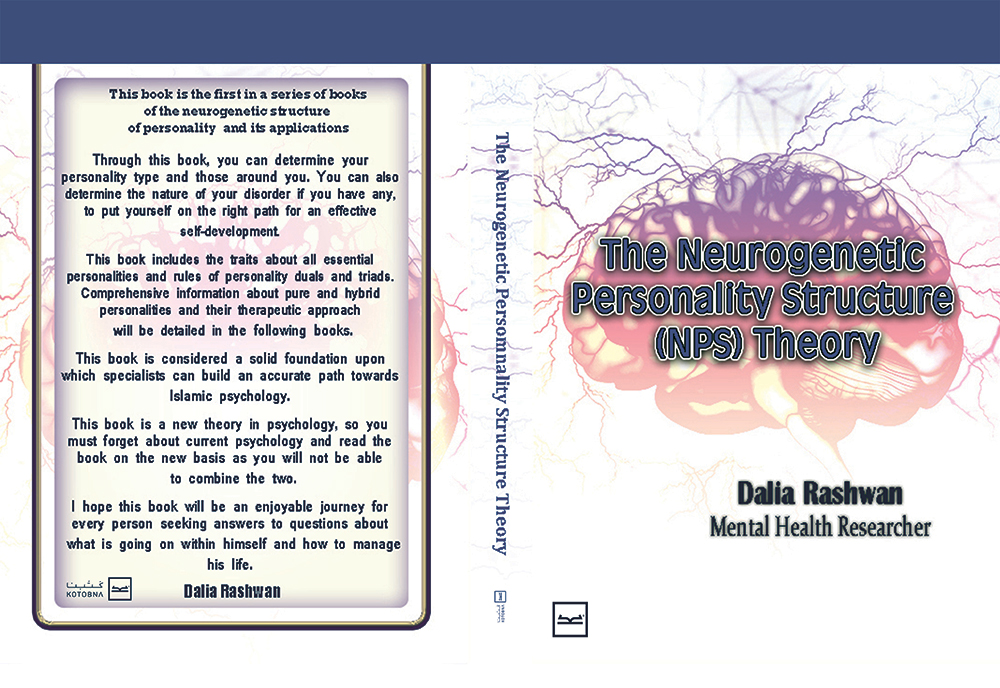
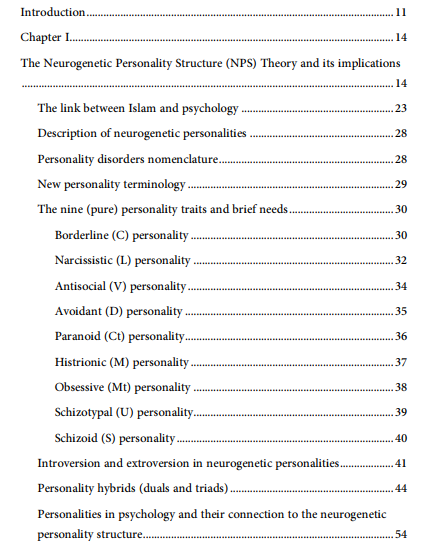
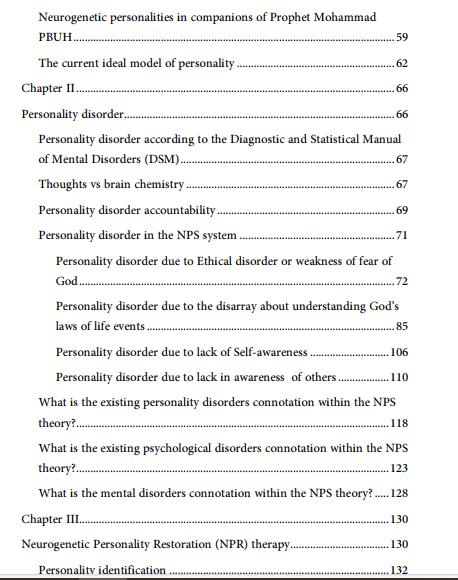
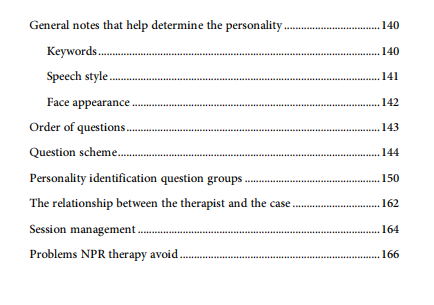
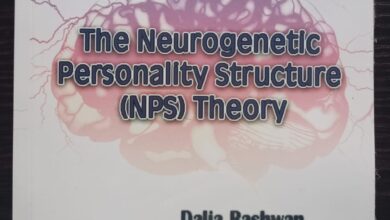
The table of contents of the Neurogenetic Personality Structure theory book

Neurogenetic Personality Structure Theory
A Foundational Overview
The Neurogenetic Personality Structure Theory presents an integrative framework for understanding human personality as a biologically rooted, neurologically structured system rather than a purely behavioral or environmentally constructed phenomenon. It proposes that personality is not an accidental psychological formation, nor merely a product of upbringing, trauma, or social conditioning. Instead, it is the expression of inherited neurogenetic patterns that shape perception, motivation, emotional processing, cognition, and behavioral tendencies from birth.
This theory emerged in response to long-standing limitations within classical psychiatric and psychological models—particularly categorical diagnostic systems that fragment human experience into isolated disorders. Traditional frameworks often treat personality disorders as pathological deviations from a presumed norm. In contrast, the Neurogenetic Personality Structure Theory reframes personality variations as functional neurobiological types, each possessing adaptive roles, cognitive advantages, emotional needs, and characteristic vulnerabilities.
Personality as Neurogenetic Architecture
At the core of the theory lies the concept that the human nervous system is predisposed toward specific structural-functional configurations. These configurations influence:
- Baseline emotional intensity
- Threat perception and safety processing
- Cognitive speed and associative activity
- Social orientation and relational needs
- Motivational drives and reward systems
- Coping and defense strategies
Rather than viewing behavior as situationally improvised, the theory posits that individuals operate through pre-wired neuropsychological circuits. Life experiences may modify expression, but they do not create the underlying structure.
Thus, personality becomes analogous to a neurological “operating system”—stable in architecture, dynamic in output.
The Nine Core Neurogenetic Personalities
The theory identifies nine primary personality structures, each representing a distinct neurogenetic blueprint. These are not disorders but functional adaptive systems:
- Creative Personality (Borderline)
Characterized by high cognitive velocity, emotional depth, creativity, perfectionism, and intense productivity. It possesses vast generative capacity but requires structured energy management to prevent exhaustion. - Leadership Personality (Narcissistic)
Defined by strategic cognition, emotional regulation, planning ability, authority orientation, and social command. It stabilizes systems through vision, hierarchy, and executive control. - Vigilant Personality (Antisocial)
Specialized in confrontation, boundary enforcement, risk navigation, and tactical response. It is neurologically equipped for hostile or unjust environments requiring assertive intervention. - Constabulary Personality (Paranoid)
Oriented toward threat detection, suspicion analysis, and protective anticipation. It imagines worst-case scenarios as a defensive forecasting mechanism. - Diligent Personality (Avoidant)
Marked by precision, restraint, ethical sensitivity, and adaptive compliance. It excels in sustained effort, refinement, and conscientious execution. - Methodical Personality (Obsessive)
Structured around order, systemization, procedural thinking, and detail governance. It preserves institutional continuity and technical accuracy. - Media Personality (Histrionic)
Expressive, communicative, and visibility-oriented. It transmits ideas socially through performance, persuasion, and emotional broadcasting. - Steady Personality (Schizoid)
Emotionally self-contained, cognitively independent, and internally stabilized. It functions efficiently in solitude, abstraction, and non-social domains. - Uncommon Personality (Schizotypal)
Neurologically tuned toward unconventional perception, symbolic cognition, and non-linear associations. It often produces rare insights beyond consensus frameworks.
Personality Combinations
Pure personality structures are statistically rare. Most individuals embody binary or ternary neurogenetic combinations, producing complex behavioral mosaics.
For example:
- Creative + Leadership → Visionary innovators
- Leadership + Vigilant → Power enforcers
- Creative + Diligent → Productive perfectionists
- Leadership + Constabulary → Strategic skeptics
These combinations explain the diversity of human functioning more effectively than singular diagnostic labels. Behavioral contradictions within individuals often dissolve when understood as the interaction of multiple neurogenetic drivers.
Reframing Psychological Disorders
One of the theory’s most transformative propositions is that many conditions classified as “mental disorders” are not primary diseases but dysregulations within otherwise functional personality systems.
For instance:
- Anxiety may reflect hyperactivation of threat-detection circuits.
- Obsessive patterns may represent overextension of methodical cognition.
- Emotional volatility may arise from creative overexertion.
Symptoms emerge when:
- Environmental demands mismatch personality structure.
- Core psychological needs are chronically unmet.
- Energy expenditure exceeds neurological capacity.
- Defense systems remain in prolonged activation.
Thus, pathology is reframed as structural imbalance, not structural defect.
The Concept of Personality Energy
A central regulatory principle in the theory is “personality energy.” Each neurogenetic structure operates with a distinct energetic economy—how it generates, expends, and restores psychological resources.
For example:
- Creative personalities generate high output but deplete rapidly.
- Diligent personalities sustain long-term effort with slow burn.
- Leadership personalities conserve energy through delegation.
Understanding energy patterns allows for predictive management of burnout, withdrawal, impulsivity, or collapse states.
Adaptive Roles in Human Civilization
The theory further argues that neurogenetic personalities evolved to fulfill complementary civilizational functions:
- Leadership structures build governance systems.
- Creative structures drive innovation.
- Vigilant structures enforce justice.
- Methodical structures maintain institutions.
- Media structures disseminate culture.
No personality is inherently superior or inferior; each becomes dysfunctional only when operating outside its ecological or societal niche.
Clinical and Applied Implications
The Neurogenetic Personality Structure Theory offers multidimensional applications:
1. Psychotherapy
Treatment shifts from symptom suppression to structural alignment—helping individuals operate in harmony with their neurogenetic design.
2. Education
Learning models can be tailored to cognitive velocity, motivational triggers, and sensory tolerance.
3. Occupational Placement
Career compatibility improves when professional demands match personality circuitry.
4. Relationship Dynamics
Interpersonal conflict often reflects structural misunderstanding rather than moral failure.
5. Creative and Leadership Development
High-capacity personalities can be trained in energy governance and strategic channeling.
Beyond Pathology: Toward Structural Literacy
Ultimately, the theory calls for a paradigm shift—from diagnosing disorders to cultivating structural literacy about human neurodiversity.
Understanding personality as neurogenetic architecture:
- Reduces stigma
- Enhances self-awareness
- Improves social cooperation
- Refines therapeutic precision
- Expands leadership and educational models
It invites psychology and psychiatry to evolve from illness classification systems into integrative sciences of human structural variation.
Conclusion
The Neurogenetic Personality Structure Theory does not deny the reality of psychological suffering. Rather, it contextualizes suffering within biologically meaningful frameworks. By recognizing inherited neural blueprints, it provides a coherent model explaining behavioral consistency, emotional intensity, cognitive style, and adaptive roles across individuals.
In doing so, it transforms personality from a diagnostic label into a functional identity—structured, intelligible, and developmentally actionable.
This framework aspires to bridge neuroscience, psychology, and lived human experience, offering both scholars and practitioners a new lens through which to understand the architecture of the self.
The following pics are the table of content of the Neurogenetic Personality Structure theory book
It is the first book in a series that will describe details about the thinking patterns of every personality.